
The Accents and Outfits of Makerere’s Architecture
What moral direction do Makerere’s architectural clothes announce, and what do they reveal about the Hill’s long work of dressing knowledge, faith, science and African becoming?
By Lorna Okeng Atim

"Hatching a New Generation" sculpture initiated in 1943 by Prof. Gregory Kakooza and completed and installed in 1997 by a team of artists led by Prof. George Kyeyune including Patrick Lwasampijja. Photo: Franklin Kasumba

Mwalimu Nyerere Bust (June, 2013). Bronze metal sculpture by Dr. George Kyeyune. Photo: Franklin Kasumba
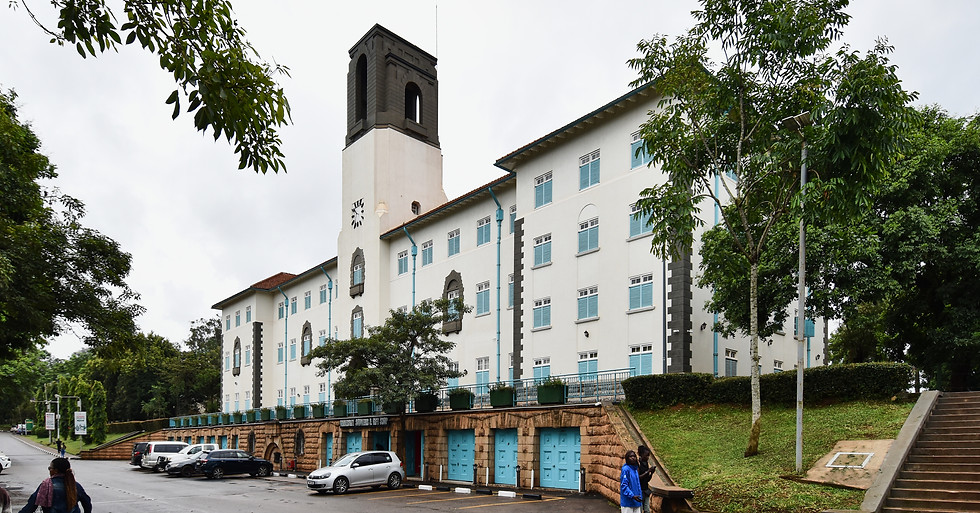
The reconstructed Ivory Tower Building, Makerere University (Photo taken 24 March 2026 following downpour) Photo: Franklin Kasumba
The Hill’s well-attired wardrobe and its part in the beautification of the world
Just over a quarter into the 21st century, Makerere University offers a unique chance to confront a question modern urban centres often sidestep: the obligation a place has to beauty, and the sort of inhabitants these spaces hoped to make.
One travels from city to city and finds, with some melancholy, that the world has become skilled at reproducing sameness. It is possible to arrive in a new place and feel one has not travelled at all. We often pretend architecture is mute until a plaque explains it. But buildings indeed speak constantly.
It is still possible to walk through Makerere and feel that buildings have temperaments. The Hill presents a wardrobe of architectural garments by which knowledge has been clothed for over a century. Some garments are liturgical, some scientific, some industrial, some so modest that they require a second look.
Makerere has special authority in this matter because beyond simply being a Ugandan institution, it has historically been a continental rehearsal room and breeding ground for presidents, writers, scientists, artists and pan-Africanists alike. The institution has an extensive legacy of producing heads of state from Tanzania’s Nyerere and Mpaka, Kenya’s Kibaki, DRC’s Kabila to the prolific lineup of literary authors and philosophers including Ngũgĩ wa Thiong'o.
The African Writers Conference, held in June 1962 at Makerere right before independence, gathered a generation that was trying to decide what African literature, identity and freedom might become. The Makerere students carried a strange sense of nobility that they were the future custodians of public life, people who expected ideas to matter across academia, politics and religion. The institution presented a convergence of all three, which were part of the same vocation.
It is fitting to begin there. Philippians 4:8 offers a case for the theory of attention and is the organising principle in this brief. It instructs believers to chase after whatever is true, noble, right, pure, lovely, and to think about such things only. It also argues that if we were indeed made in God’s image, we must command attention to beauty as a discipline of the mind. It then goes on to invite us to become more careful observers and insists that loveliness is one of the things truth must wear.
In other words, we become what we repeatedly notice. A university that surrounds its students with ugliness teaches them quietly that the world is not worth careful regard, while one that dresses science, experimentation and worship with beauty teaches that knowledge has some kind of obligation to the soul.
We organise our homesteads and cities. If we can get a sense of someone’s values and interests from the shirt they wear, then perhaps the demeanour of a building may give us a window into the soul of the people it houses. I am particularly interested in exploring what moral direction Makerere’s architectural clothes announce about its inhabitants: what do the chapel mosaics, zoological murals and laboratory bones tell us it once wanted its students to become?
I initially explored this experiment as a cocktail of the accents; the intangible stories, events and untouchables that these buildings stored; and the outfits, the more tangible, touchable elements. A lot has been captured on the tangible wardrobe; very little is available on the accents. I hope to expand on this in my next iteration.
St. Francis Chapel mural depiction of the Canticle of the Sun. Photo: Franklin Kasumba

From a Lecture to a Sermon: St Francis Chapel
“I will enter His gates with thanksgiving in my heart,” a nostalgic nursery and Sunday school rhyme, is the correct posture for approaching St Francis Chapel, based on the plethora of artworks that usher the unexpecting visitor in.
St Francis Chapel is not shy at all. The West Front mosaic, depicting the Canticle of the Sun, St Francis’s hymn of praise, is perhaps the chapel’s most generous lesson. The mural welcomes the visitor with a large billboard and advertisement of praise to Brother Sun, Sister Moon, Brother Fire, Sister Water and even Sister Bodily Death. These siblings of creation play out that all of creation was meant to worship God, the Author and Finisher of Faith. They are all His creation and congregants. There is deep admiration to be had for how biblical text comes alive in these relics, something contemporary practice may need to borrow and apply more often. It is difficult to think of a better entrance for a university chapel.
The chapel was built in 1942, first used on Advent Sunday and dedicated in 1947 to Almighty God in honour of St Francis of Assisi. Interestingly, St Francis himself is a paradox perfectly suited to an essay on clothing. The son of a cloth merchant who renounced vanity, having been said to have received the instruction to “rebuild my church” from God, yet believed sacred life should not be starved of beauty. Poverty, for Francis, did not mean ugliness but rather a refusal to amass material possessions while still offering God the best.
The chapel’s 1963 expansion, just one year after Uganda’s independence, in a period of nationalism, African pride and the attempt to Africanise inherited forms, saw a fascinating representation of beauty through the ceiling murals. It was expanded in 1963, just after Uganda’s independence, when Africanisation, nationalism and cultural confidence became visible artistic decisions rather than a transplanted ecclesiastical collection of objects.
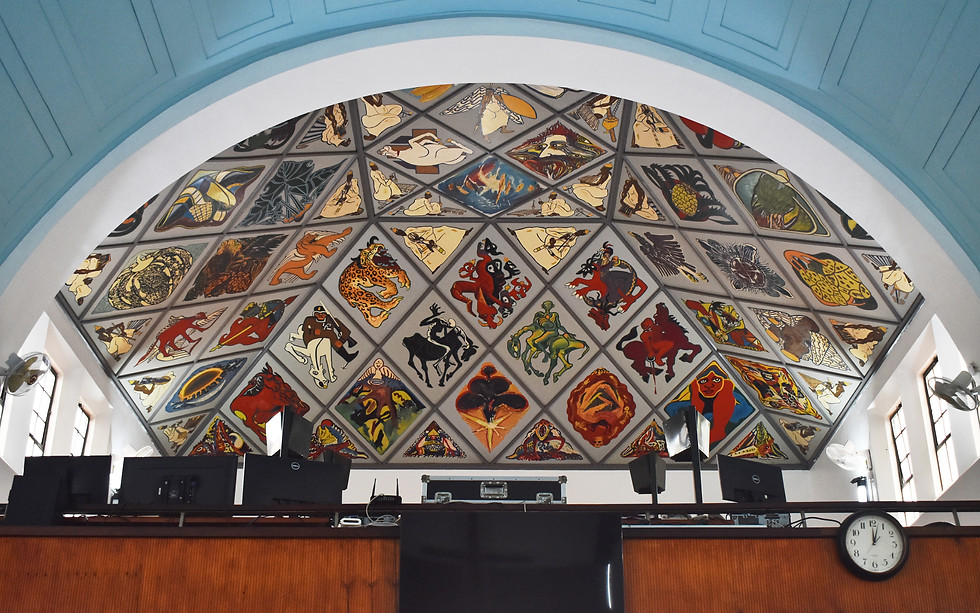
St. Francis Chapel 57 panel ceiling mural explaining the Book of Revelation of John. Photo: Franklin Kasumba
The mosaic art works in gold in the lunettes over the entrance, eagle, fish, lamb, are small but precise acts of theological clothing. The eagle is a symbol of God; the fish recalls early Christian recognition, while the lamb carries sacrifice and victory, as seen in the lamb of John 1:29 and Revelation. The Chi-Rho, a theological jewellery on the floor, is more intimate still because it is crossed by the feet and a symbol of Christ. It was traced by Archbishop Leslie Brown with his pastoral staff after the 1963 extension.
One of the 3 mosaic art works(the eagle, fish, lamb) in the lunettes as seen in the image on the left. The fish has been a symbol of the church. The initials in the Chi-Rho mean “Jesus Christ, Son of God, Saviour” Photo: Franklin Kasumba

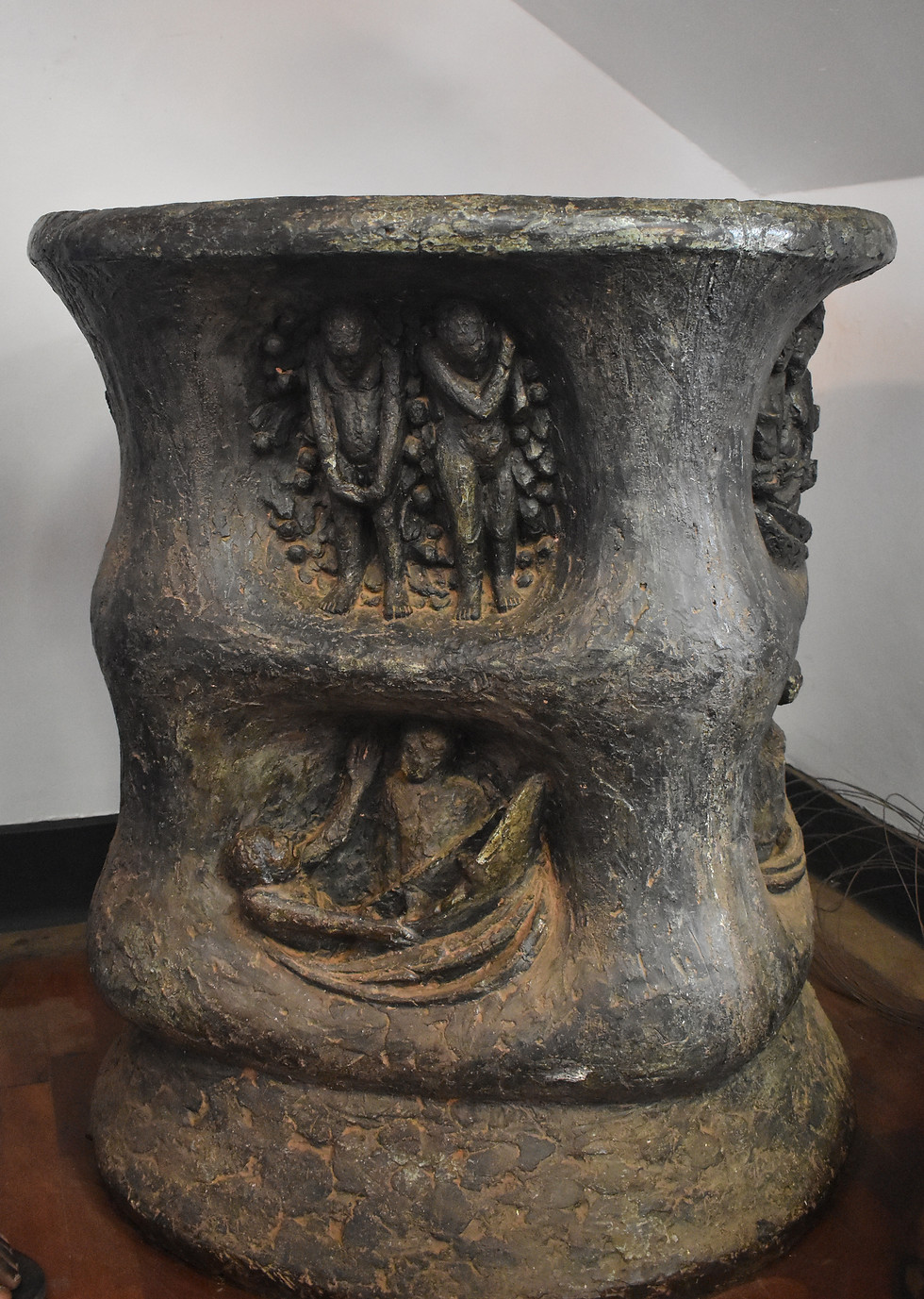
Inside, Gregory Maloba’s baptismal font is cast in cement fondu with a beaten copper basin, carrying biblical scenes of new life. Elimo Njau’s St Francis Preaching to Animals restores animals to the moral imagination. Jonathan Kingdon’s bronze pelican lectern, The Pelican in her Piety, turns reading into an image of sacrifice. The 57 Revelation panels in the gallery ceiling, the most eye-catching, make apocalypse colourful, leaning to the Africanity of that time and musical as the heavens are often depicted. The most striking is that the elders are Black, seated on African stools, playing Ugandan instruments. The chapel therefore does what good architecture should do: it edifies.
And yet, one must ask, since that independence-era flowering that dressed the chapel with such confidence, what has been added? Each generation is expected to build on the previous one’s knowledge and contribute to the visible archive of faith, science and civic imagination of its time. Did that expectation relax? Or did the 21st-century Makerere student become so globally switched on, so attuned to many worlds, that no single visual
anguage could dress their ideas? Still, a lack of singular taste need not become a lack of offering.
Gregory Maloba’s baptismal font, Photo: Franklin Kasumba


St. Francis Chapel 57 panel ceiling mural explaining the Book of Revelation of John. Photo: Franklin Kasumba
The mosaic art works in gold in the lunettes over the entrance, eagle, fish, lamb, are small but precise acts of theological clothing. The eagle is a symbol of God; the fish recalls early Christian recognition, while the lamb carries sacrifice and victory, as seen in the lamb of John 1:29 and Revelation. The Chi-Rho, a theological jewellery on the floor, is more intimate still because it is crossed by the feet and a symbol of Christ. It was traced by Archbishop Leslie Brown with his pastoral staff after the 1963 extension.
One of the 3 mosaic art works(the eagle, fish, lamb) in the lunettes as seen in the image on the left. The fish has been a symbol of the church. The initials in the Chi-Rho mean “Jesus Christ, Son of God, Saviour” Photo: Franklin Kasumba
Inside, Gregory Maloba’s baptismal font is cast in cement fondu with a beaten copper basin, carrying biblical scenes of new life. Elimo Njau’s St Francis Preaching to Animals restores animals to the moral imagination. Jonathan Kingdon’s bronze pelican lectern, The Pelican in her Piety, turns reading into an image of sacrifice. The 57 Revelation panels in the gallery ceiling, the most eye-catching, make apocalypse colourful, leaning to the Africanity of that time and musical as the heavens are often depicted. The most striking is that the elders are Black, seated on African stools, playing Ugandan instruments. The chapel therefore does what good architecture should do: it edifies.
And yet, one must ask, since that independence-era flowering that dressed the chapel with such confidence, what has been added? Each generation is expected to build on the previous one’s knowledge and contribute to the visible archive of faith, science and civic imagination of its time. Did that expectation relax? Or did the 21st-century Makerere student become so globally switched on, so attuned to many worlds, that no single visual language could dress their ideas? Still, a lack of singular taste need not become a lack of offering.
Gregory Maloba’s baptismal font
Jonathan Kingdon’s bronze pelican lectern
From a Lecture to a Sermon: St Francis Chapel
The "Canticle of the Sun" mural at St Francis Chapel. Photo: Franklin Kasumba
“I will enter His gates with thanksgiving in my heart,” a nostalgic nursery and Sunday school rhyme, is the correct posture for approaching St Francis Chapel, based on the plethora of artworks that usher the unexpecting visitor in.
St Francis Chapel is not shy at all. The West Front mosaic, depicting the Canticle of the Sun, St Francis’s hymn of praise, is perhaps the chapel’s most generous lesson. The mural welcomes the visitor with a large billboard and advertisement of praise to Brother Sun, Sister Moon, Brother Fire, Sister Water and even Sister Bodily Death. These siblings of creation play out that all of creation was meant to worship God, the Author and Finisher of faith. They are all His creation and congregants. There is a deep admiration to be had for how biblical text comes alive in these relics, something contemporary practice may need to borrow and apply more often. It is difficult to think of a better entrance to a university chapel.
The chapel was built in 1942, first used on Advent Sunday and dedicated in 1947 to the Almighty God in honour of St Francis of Assisi. Interestingly, St Francis himself is a paradox perfectly suited to an essay on clothing. The son of a cloth merchant who renounced vanity, having been said to have received the instruction to “rebuild my church” from God, yet believed sacred life should not be starved of beauty. Poverty, for Francis, did not mean ugliness but rather a refusal to amass material possessions while still offering God the best.
The chapel’s expansion in 1963, just a year after Uganda’s independence, in a period of nationalism, African pride and the attempt to Africanise inherited forms, saw a fascinating representation of beauty through the ceiling murals, where Africanisation, nationalism and cultural confidence became visible artistic decisions rather than a transplanted ecclesiastical collection of objects.
St. Francis Chapel 57 panel ceiling mural explaining the Book of Revelation of John. Photo: Franklin Kasumba

Cecil Todd’s "Vertebrates and Invertebrates" mural on the Department of Zoology, Entomology & Fisheries, Makerere University. Photo: Rebecca Khamala

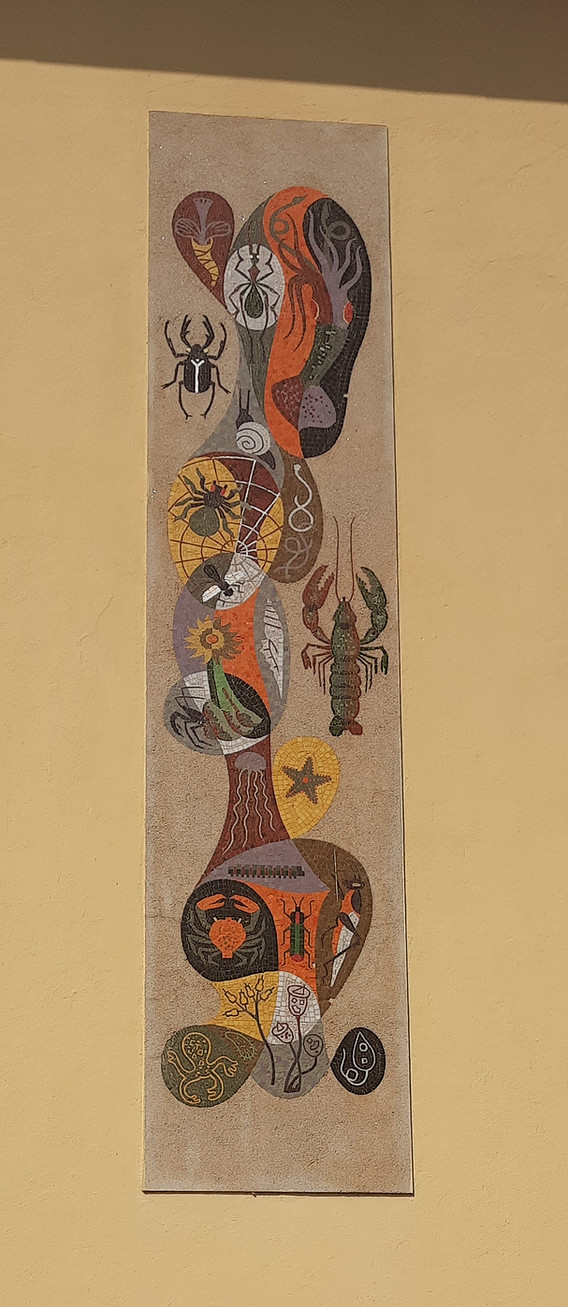
Vertebrates mural on the left of building Photo: Rebecca Khamala
Invertebrates mural on the right of building. Photo: Rebecca Khamala
Zoology: A Lecture on the Intelligence of Creaturely Form
At the entrance of the Department of Zoology, Entomology & Fisheries, the visitor is greeted by a different kind of moral education, less concerned with praise. It is a lecture in a mural of living forms in motion; the walls invite visitors to a classification of living things.
Cecil Todd’s vertebrate and invertebrate mural belongs to a period when Makerere Art School was wrestling with modernism, African identity and technique. Todd’s work is described as a twin mural of fauna, composed with mosaic-like colour and technical rendering. Created towards the end of the colonial years before the 1960s and during his time as Head of the Makerere Art School from 1958 to the late 1960s, it takes what might have remained in taxonomy diagrams and specimen drawers and gives it a façade. Long before digitisation, there was this mosaic wall artwork, capturing the differences between the geometric and the spatial.
The department’s present work makes the mural feel prophetic. It now describes itself through biodiversity conservation, vector ecology and hosts a plethora of global datasets of species. In 2018 and 2019, butterfly records and Mabira Forest Lepidoptera specimens from Makerere became part of digital biodiversity memory.
There is a quiet democracy in the mural. Vertebrate and invertebrate stand beside one another. This is where biomimicry enters as more than design and fashion inspiration. They show that nature has been engineering since the onset of time and presents an incredible opportunity to see design between the geometric and the spatial.
The Chimney-Looking Building with Accents Yet to Be Written About
The outfit that arrested my attention the most has got to be what I left describing as the chimney/lab building, and it is the hardest to write about because its archive is quieter. With its long roof and alert vertical stack, it seems like the kind of person who says little because it has spent a lifetime doing practical work. Its provenance, exact events and original use need deeper research, and therefore I resist writing about its intangible elements too eagerly.
Still, the building speaks through its body. Its strong bones, long roofline, repeated windows, deep eaves and chimney suggest it could have housed some type of experimentation. I imagine this would have been a chemistry lab not repurposed.
Failed experiments, long afternoons, unnamed technicians, students washing glassware, lecturers improvising equipment, fumes rising, rain striking roofs, a nation learning to manufacture knowledge I imagine. But this is a particular outfit I am fascinated by.
The Hill’s wardrobe therefore has numerous garments. Others are louder than others. Together they suggest that Makerere’s highest calling beyond producing graduates was to form people whose knowledge could be beautiful, whose beauty could be useful and whose usefulness could serve the world.
Lorna Okeng Atim
Lorna Okeng Atim is a Ugandan creative technologist, immersive curator and strategic foresight researcher working at the intersection of alternative futures, speculative design, digital minds and emerging technologies. With over nine years’ experience across internet and emerging technology spaces, including Google, Vodafone and Electric South, her work explores new frontiers of storytelling across immersive media, virtual worlds and machine-mediated societies. Her practice is especially concerned with the ethical stewardship of emerging technologies and their implications for imagination, culture, creativity and future human experience.
She is the producer and director of Uganda’s first virtual reality film, Keepers of the Forest: The Batwa Legacy and a creative and digital economy research and policy consultant focused on African and emerging markets.
Lorna is a member of the World Metaverse Council, a Lifeboat Foundation Art and Media Advisory Board member, Focal Point of the Alternative and Indigenous Futures Hub at the School of International Futures and an Afterlives of Return Visiting Fellow at the University of Cambridge.

"The diamond of the season." Photo: Franklin Kasumba
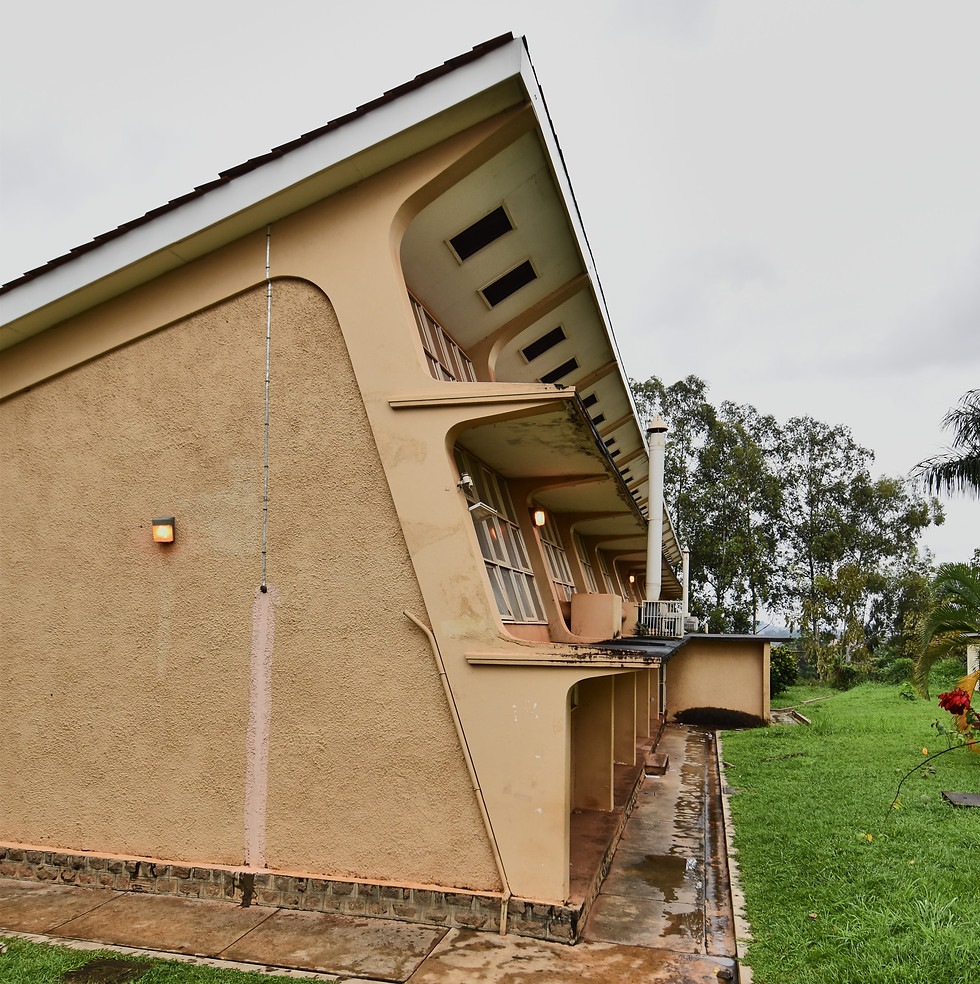
The Department of Chemistry Building, Makerere University. Photo: Franklin Kasumba
The diamond of the season. Photo: Franklin Kasumba